Email from Storm 2-16-2026 announcing this:
I poked around on the Thorlabs site looking at neutral density filters and SMA couplers, thinking about ideas for an SMA attenuator I could use with my Thunder Optics or Ocean Optics HG-1, Hg/Ar calibration sources, so I could plug these into the B&W Tek spectrometer without saturating it. One thing that I did find out is that they sell calibrated SMA attenuators which you insert between 2 SMA cables. All they do is introduce an air gap between the ends of the two fibers, lowering the coupling efficiency. Anyway, something for the future.
While I was pondering this, I thought of a dirt-cheap calibrator idea to use with our B&W Tek spectrometers,
based on Tom's use of an uncoated mercury lamp (UVC mercury lamp).
For what we need, the spectral lines produced by a simple Hg lamp are in the perfect range.
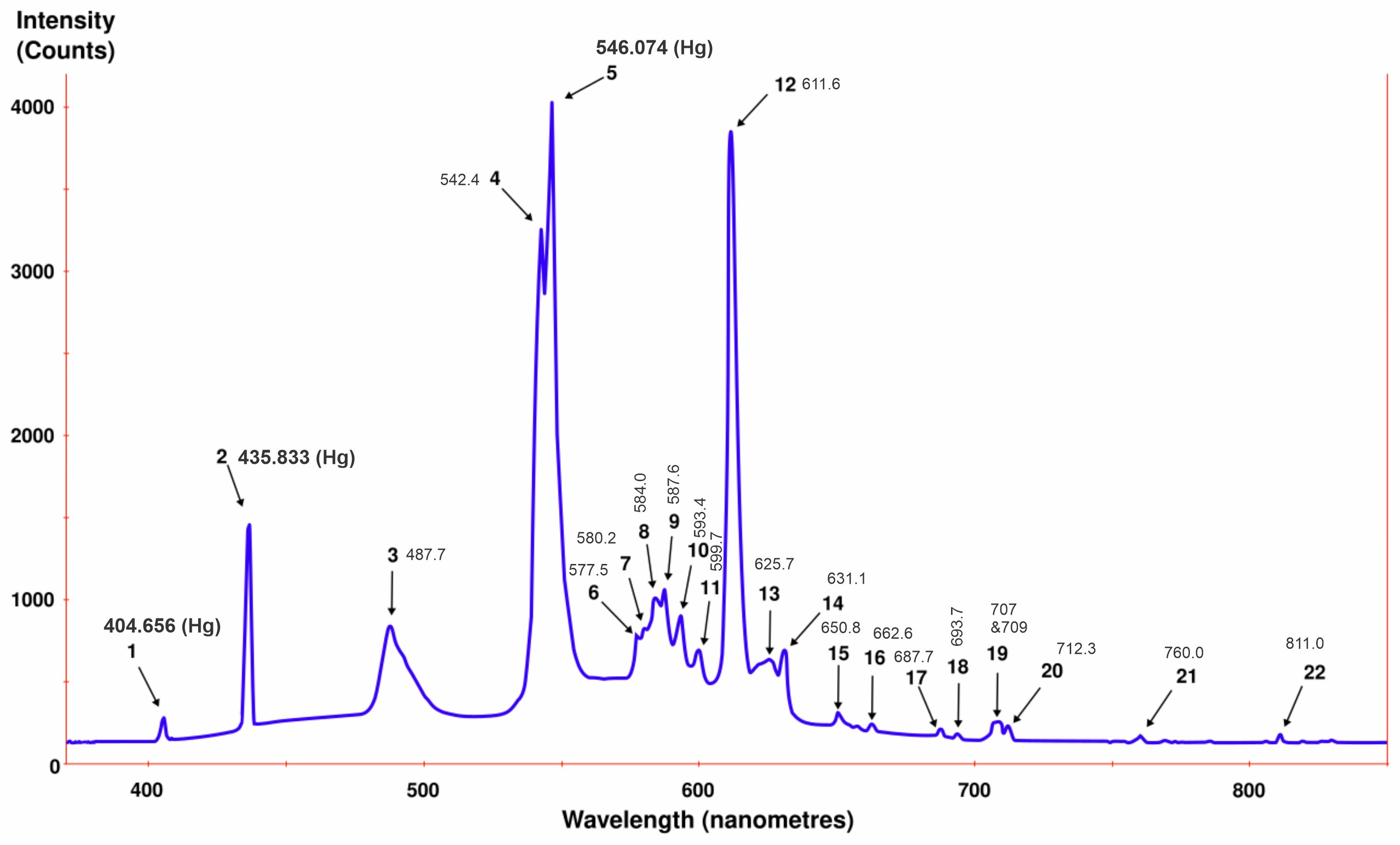
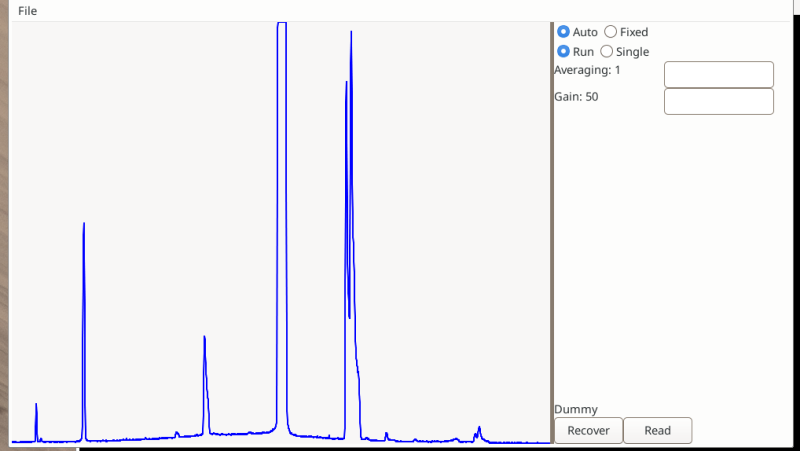
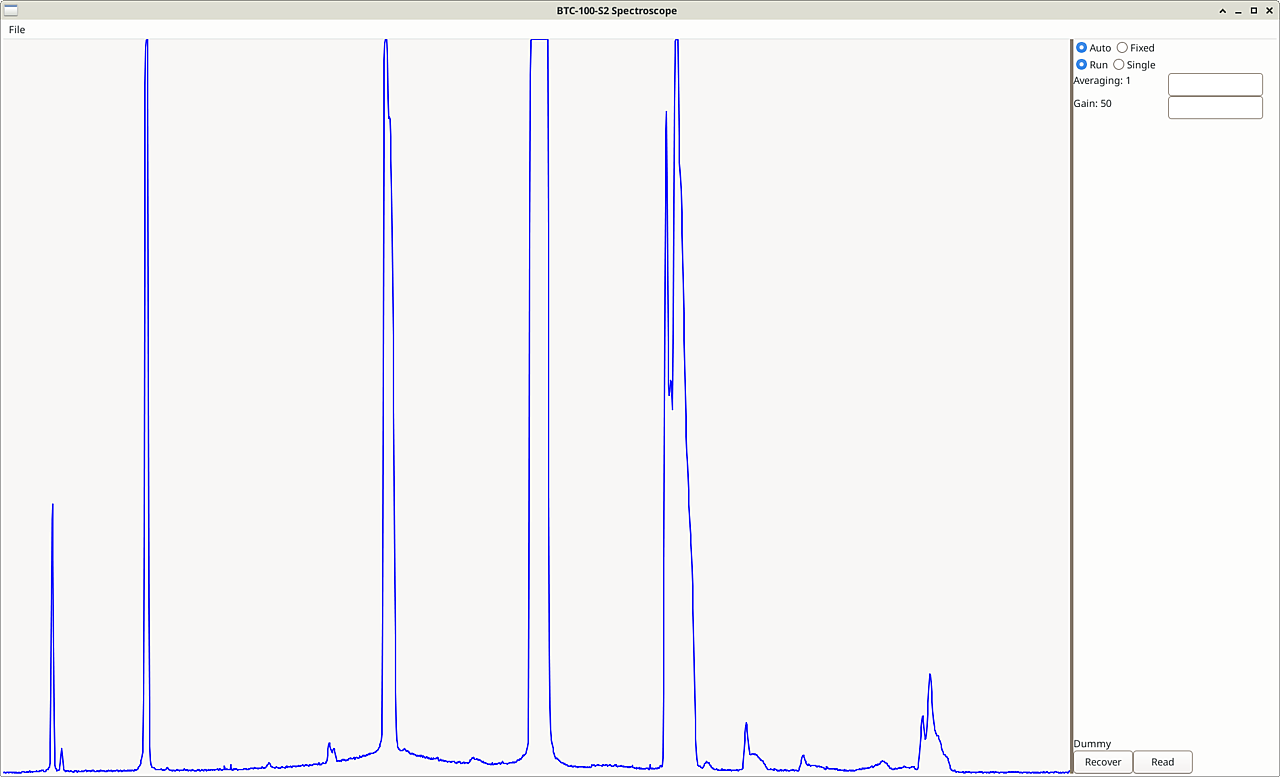
I've attached Tom's spectral scan for reference.
The primary spectral lines shown are 404.656, 435.833, 546.074, 576.96, and 579.07nm.
These span the range of the B&W Tek spectrometer pretty well and provide enough points for a polynomial calibration.
(note the double line at 576.96 and 579.07).
So, I purchased one of these ePROM erasers on Amazon:
I paid $5 more than the lowest price ($30.58) so that I can try to get it by the weekend.
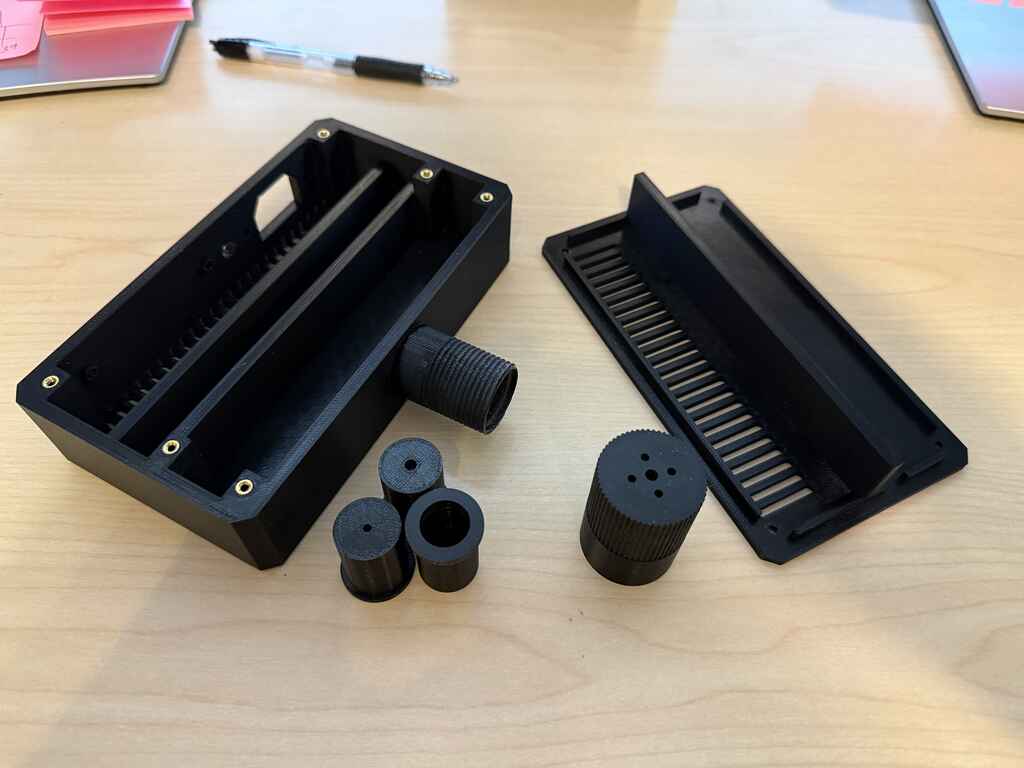
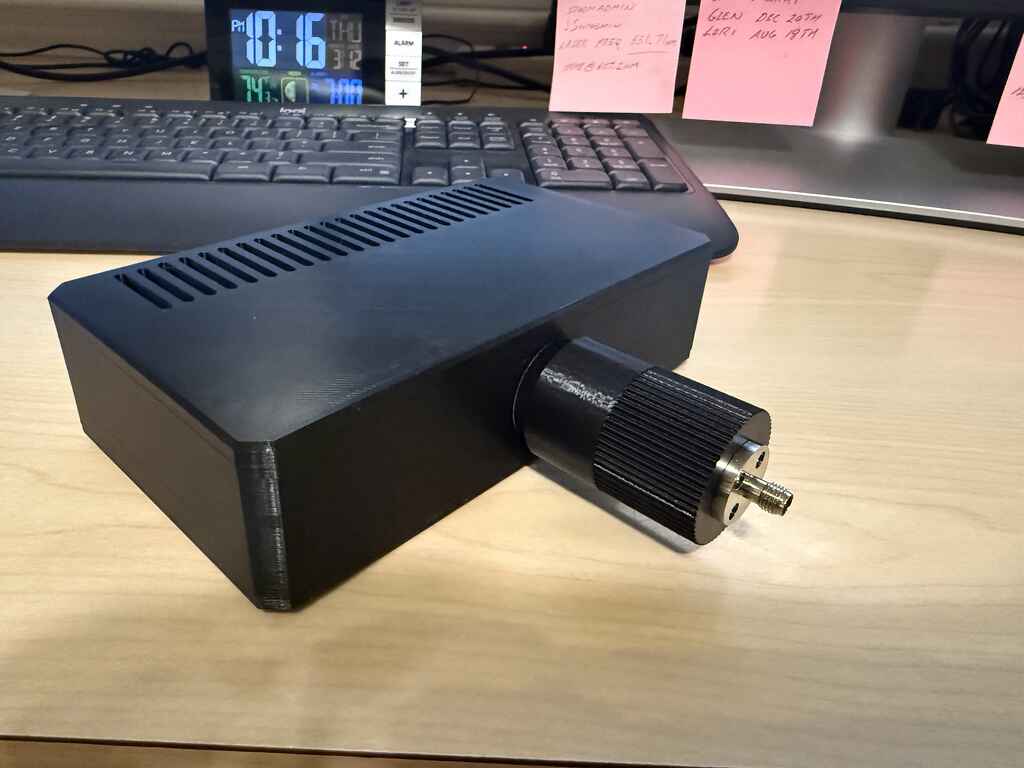
I'm going to strip out the guts, eliminate the timer, and repackage this in a new 3D printed case.
Imagine a box with a cylindrical tube coming out of the side.
The length of this tube determines the amplitude of the calibration signal.
I'll set the length of this tube so that it nominally provides the proper amplitude of calibration
signal for the B&W Tek spectrometer (546.074nm line is not saturated with 600um fiber and spectrometer set to 50ms).
I'll put a threaded cap on the end of the tube so that I can adjust the length of the tube for fine amplitude adjustment.
On the end of the tube is an SMA coupler that you screw your fiber cable into.
So, the cost of the whole rig is about $25. Is that cheap enough?
Better than trying to hold a fiber cable near a UV lamp.
Another email from Storm on 2-16-2026:
Conclusions:
A bare Hg shortwave / germicidal fluorescent lamp would make a good calibration source for the spectral range of the B&W Tek spectrometers. You would need to devise some type of holder for the end of the fiber cable. You don't really want to expose your hand or your eyes to the light emitted by a bare mercury lamp and without fixturing the cable, you would be continuously "twiddling" with it to get a good spectral capture. Even with polynomial calibration there is going to be a little bit of error, say +/- 1nm somewhere in the measurement range. What is important is that you have one or two calibration lines within the spectral range you want to measure. For example, the 546nm line is in the range of uranyl fluorescence, so we can typically expect about +/- 0.5nm in that range.
I need to build an adapter to fixture the fiber the cable to the output of the calibration source and add the necessary attenuation so that the 546nm line is not saturated at a 50msec integration time on the B&W spectrometer, preferably using the same 600um fiber cable used for measurement. I can probably achieve the necessary attenuation using inexpensive neutral density filters. Then, to measure more lines, you would increase the integration time of the spectrometer to say 100msec (546 line would become saturated, but that's okay). I'll begin work on this.
Incidentally, I found these units on eBay. They are a Chinese manufactured knockoff of the Ocean Optics HG-1 with a mixed Hg/Ar lamp. Shouldn't be anything wrong with it though, a lamp is a lamp. The Ocean Optics units, like everything else they build, is horribly overpriced for what is actually in the box. The price of these units isn't too bad.
If you have something like this, when I devise an attenuating adapter, it should work fine. I would guess that it has exactly the same output as the original Ocean Optics unit.
Email from Storm 3-13-2026 to Paul
I completed my design for an Hg reference source, it works well, and I'm ready to send one along to you.
I've attached a document with some build details of the unit, mostly for Tom's benefit. Tom: if you want me to print one of these housings for you, I don't mind. I could also include a few parts. I know you are a fervent do-it-your-selfer though.
I've also attached a document that provides spectral information on all types of sources,
both mercury and inert gases. Table 1 of the document is particularly useful.
(see above as "Typical Spectra" document).
Paul: I'm also thinking I should print up an eyepiece cap incorporating a yellow-glass cutoff filter for you. In order to maximize the fluorescence response, it is necessary to observe the specimen while adjusting the laser and the specimen position. For a couple of measurements, the stray unfocused illumination from the low power 405nm laser is a low risk. However, if you are making many consecutive measurements, I wouldn't want to take the risk. I would either have a protective filter on one of the eyepieces for observation, or I would use a scope camera for indirect observation (a pain). Please let me know if you would like something like this and for which scope. I would presume the Zeiss scope that you will be using at the LAMNH. This is an easy design based on the information I already have on hand, and would take just a couple of hours to design and print.
Email 4-2-2026 from Storm to Paul:
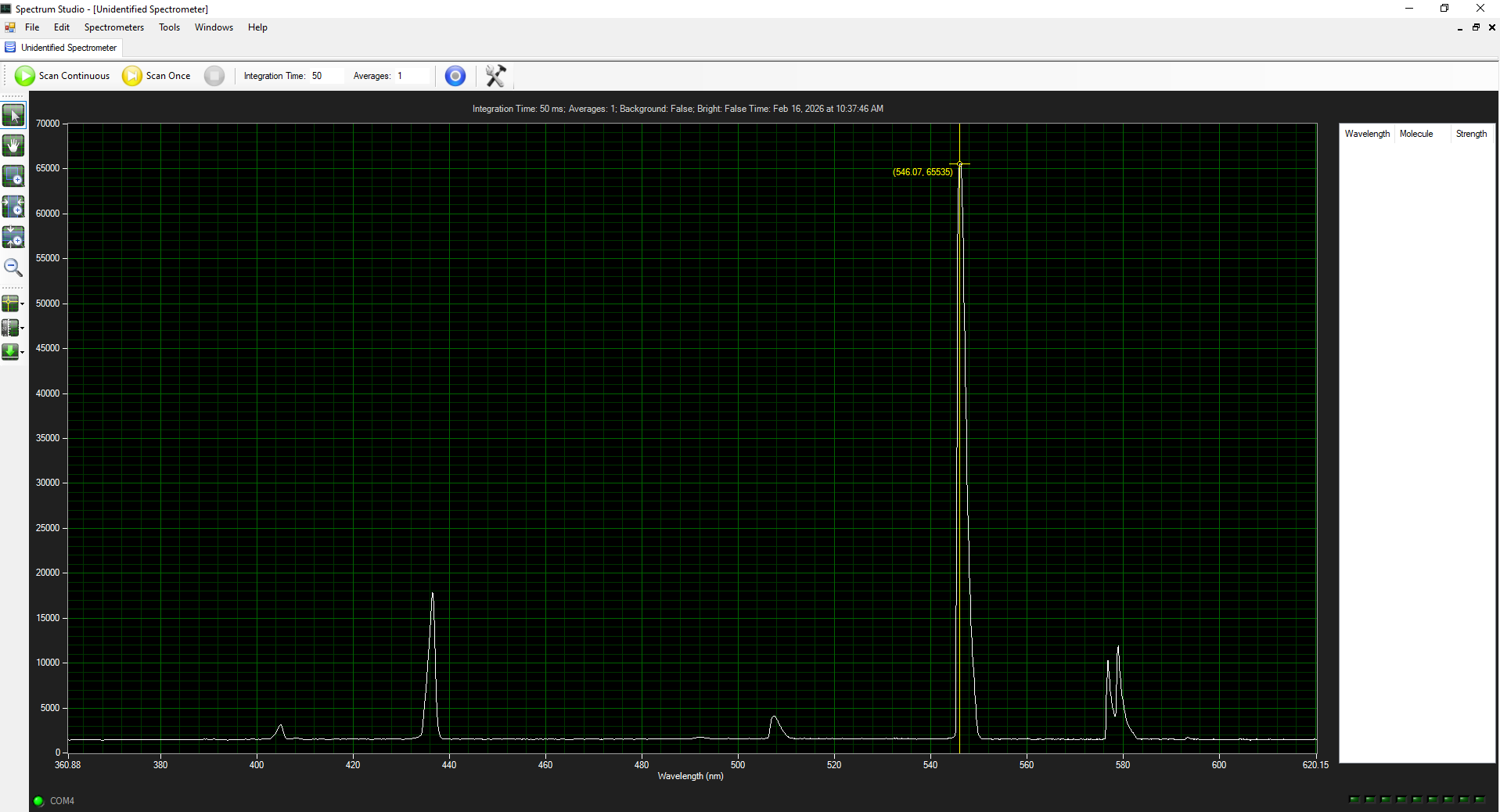
I preconfigured your Hg reference so that it should provide a proper amplitude display with a 600um cable and 50msec integration time on your B&W spectrometer. I did this by selecting a particular amplitude reducing aperture (I gave you a kit with 3 different sizes, the smallest aperture was installed in the Hg source).
The cal that you performed using the fluorescent lamp establishes that your spectrometer is working properly.
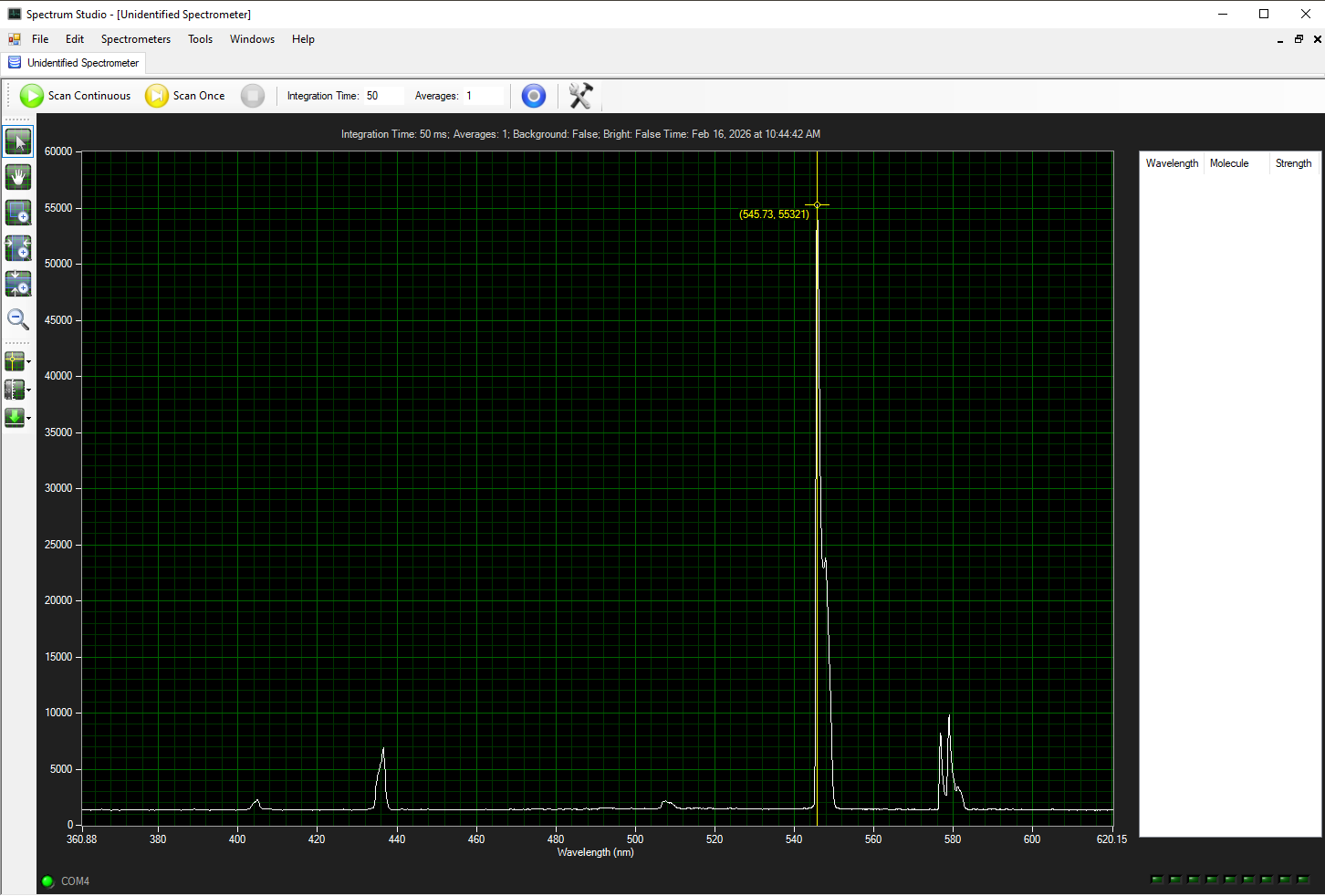
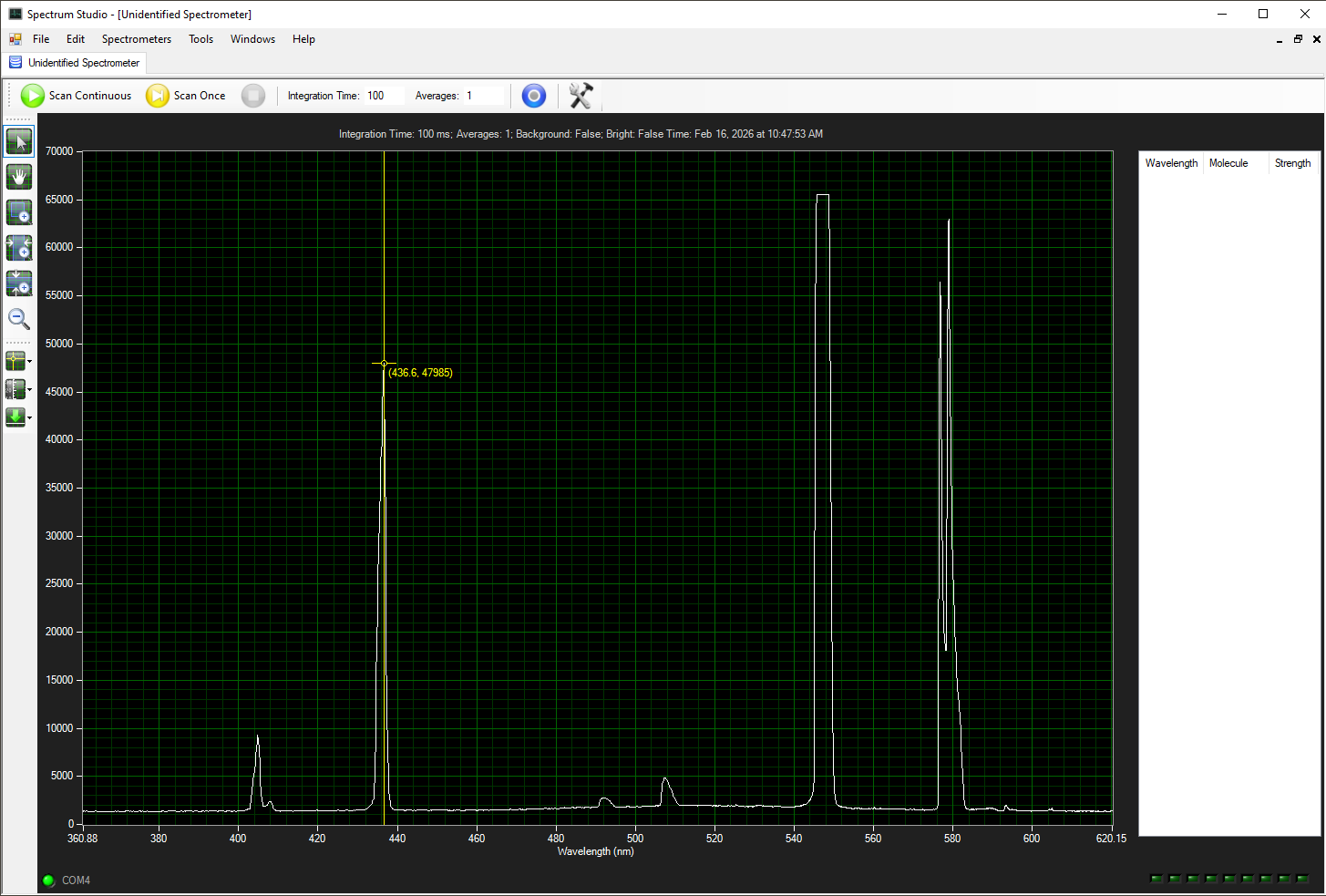
Measuring the Hg reference after calibration with the fluorescent lamp is very beneficial to me! The first scan, presumably with a 100um cable, was not providing enough amplitude; you can't even see the peak that should be present down around 404nm; however, this medium amplitude anomalous peak around 508nm pops up. In the second scan of the Hg source with a 1000um cable, the anomalous peak around 508nm went away, and things are actually looking pretty good. Some of the weaker Hg peaks, like the one at 491.6 nm, are also appearing in the spectrum. I note however, that you had to go up to an integration time of 600msec to see this display, which seems odd with the larger 1000um cable.
Next, you tried a 600um cable and a "red cable" which was presumably smaller in diameter. The 404nm peak has disappeared and 436nm peak is almost gone as well. The longer wavelength peaks look great though, exactly as I would expect.
Based on this information, I am pretty sure I know what is going on now!
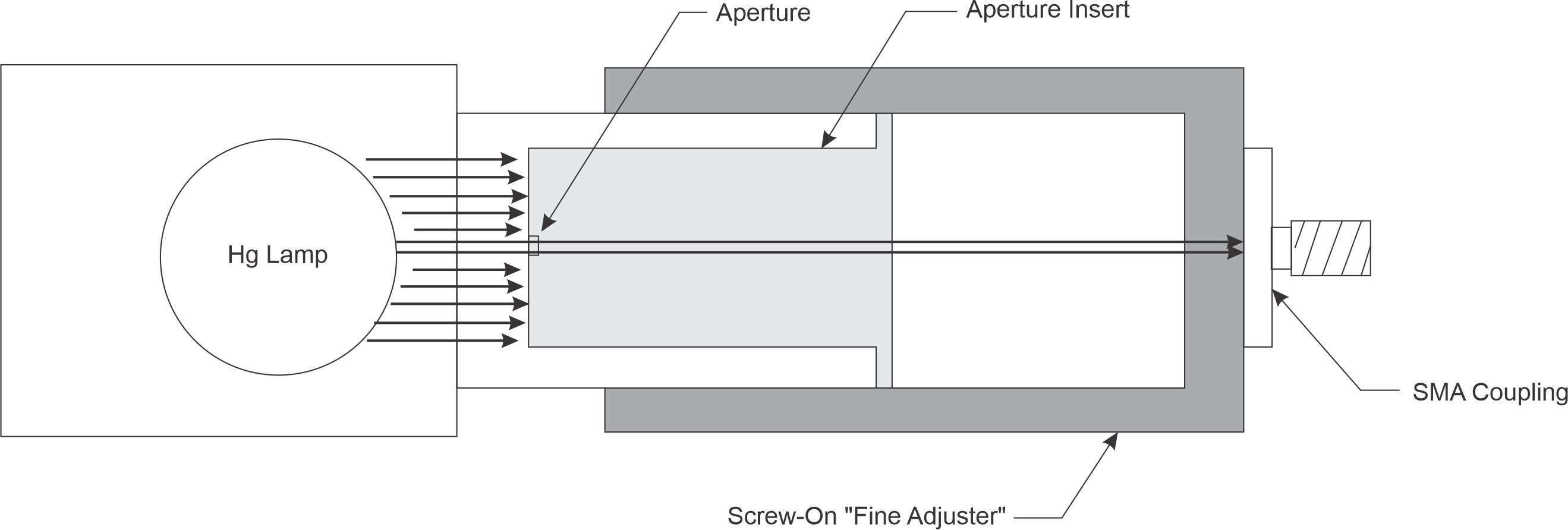
See the attached diagram showing a cross-section of the Hg reference. I cut the illumination from the Hg lamp down to usable levels by using an aperture insert which only lets some of the illumination through. As I mentioned, there was a kit of 3 aperture inserts supplied, with the smallest one installed. As the size of the aperture is reduced, alignment becomes more critical, because the light cast by the lamp has to hit the end of the fiber cable which is mounted in the SMA coupler. Obviously, the smaller the size of fiber cable employed, the "twitchier" this alignment becomes.
When the alignment of the aperture and the SMA coupler is off, especially when the smallest aperture is being employed, you can get weird diffraction effects off the edge of the aperture. This gives rise to spurious spectral emissions at resonant wavelengths. In addition, misalignment can also cause attenuation of shorter wavelength spectra. I am seeing both of these effects in your results.
There are a couple of things that you can try:
Tom's Mineralogy Info / tom@mmto.org