June 19, 2026
Thermo Scientific DXR - Dallas DS1994L-F05
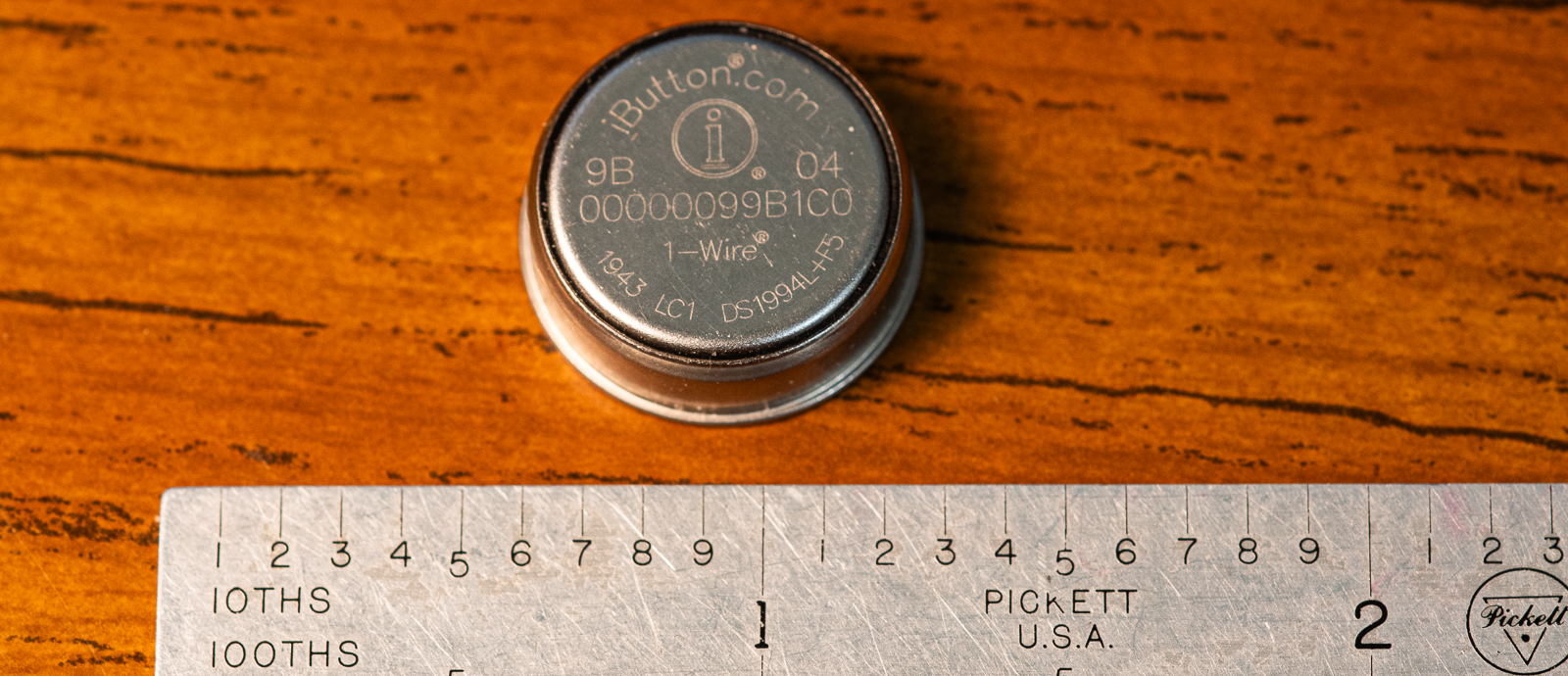
This lives in a fat coin cell package, so there are only 2 connections
to the outside world.
The chip uses the 1-wire protocol developed by Dallas Semiconductor.
Dallas Semiconductor was purchased by Analog Devices some time ago.
The company (Thermo) is less than helpful, offering replacement parts
(with uncertain shelf life questions) for $500 per unit.
The package
The "F5" in the full part number DS1994L-F5+ denotes the package,
namely an "F5 MicroCan". This provides hermetic envionmental protection,
which is nice while the battery lasts. They claim at least a 10 year life.
The date code on the one photographed is 1943 (week 43 of 2019), so it should
still be healthy in 2026 and keep going to 2029. Date codes on some of
the others were 1443 and 0715, and both of these would be expected to have
run out of gas.
The big part of the can is ground. The small part with all the laser writing
on it is the "IO" connection.
The pull up voltage is given as from 2.8 to 6.0, so this should work
directly on a 3.3 volt system.
The data sheet says time slots are from 60 to 120 us. If they were
100 us, that would be 10 kHz ballpark.
I see "standard mode" speed for 1-wire devices is 15 kHz, so this
seems like what we have.
Emulation using a microcontroller
The following project uses a PIC to act like a 1-wire slave.
He uses a PIC running with a 10 Mhz crystal, so surely a small
ARM based board (like a "blue pill" or Pico) running at 100 Mhz and up
should be completely capable.
How about an EEPROM to go with that microcontroller?
A quick search turns up this EEPROM, readily available from Adafruit for $4
with 32K bits of memory (the DS1994 only has 4K bits).
This is convenient on a little breakout board.
No doubt less expensive options could be obtained, especially if I was
willing to design a PCB.
An eeprom would avoid any need for a battery.
They rate it for 10,000,000 erase/write cycles!
Feedback? Questions?
Drop me a line!
Tom's Mineralogy Info / tom@mmto.org