One of the bulbs burned out, but they give you two spare bulbs with the unit. I bought 4 more for about $12 when I replaced the one that burned out.
This unit works great and is well worth the money. When a bug is attracted by the lights and flies in, there is a loud pop. The pop is loud enough to make me jump. I am briefly annoyed, but then pleased that another annoying insect has been eliminated.Since about when I replaced the bulb there have been no more pops. It would seem that the deadly high voltage is not being generated. Checking for high voltage is not without its hazards, and I suspect that the voltage is higher than anything my Fluke 77 is rated for (the meter says 1000 volts max). This is indeed true -- see below.
I unplugged it and opened it up. A decal on the side advises shorting and discharging the HV before replacing bulbs. I did that with no loud pop or spark -- additional confirmation that something is wrong. 4 screws allow the two black pieces on the top corners to be removed, then the top piece slides off to the left or right and you are looking at two circuit boards.
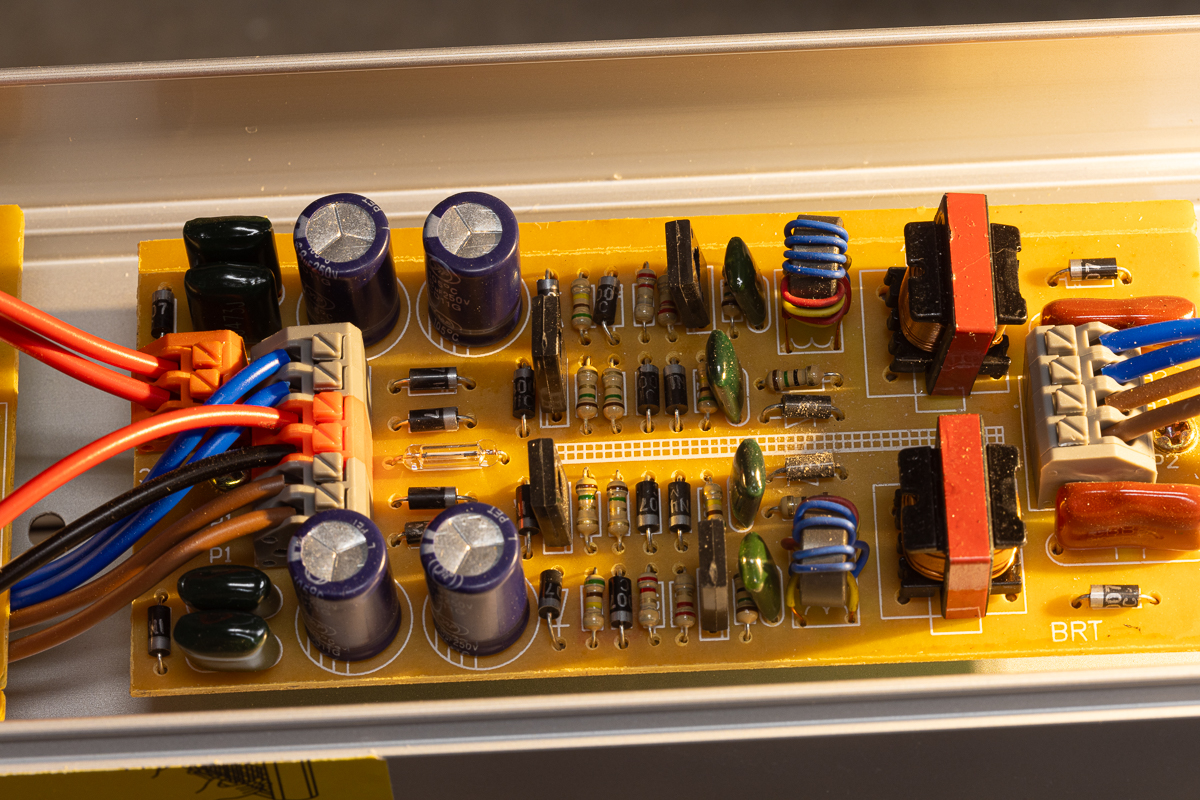
Here is the first board. Line AC comes in via the red and black wires on the center left. The 2 wires at the top left (orange) go to the next board (the high voltage board). The blue and brown wires at both left and right go to the fluorescent tubes. The tubes work just fine.
My bet is that almost all of the circuit here is to run the tubes. Indeed, when I unmount the board to inspect the traces on the underside, I find that line AC goes straight to the HV board. No fuse or "middle-man" on this board. All of this circuit is to run the fluorescent tubes.
And here is the second board (the high voltage board).
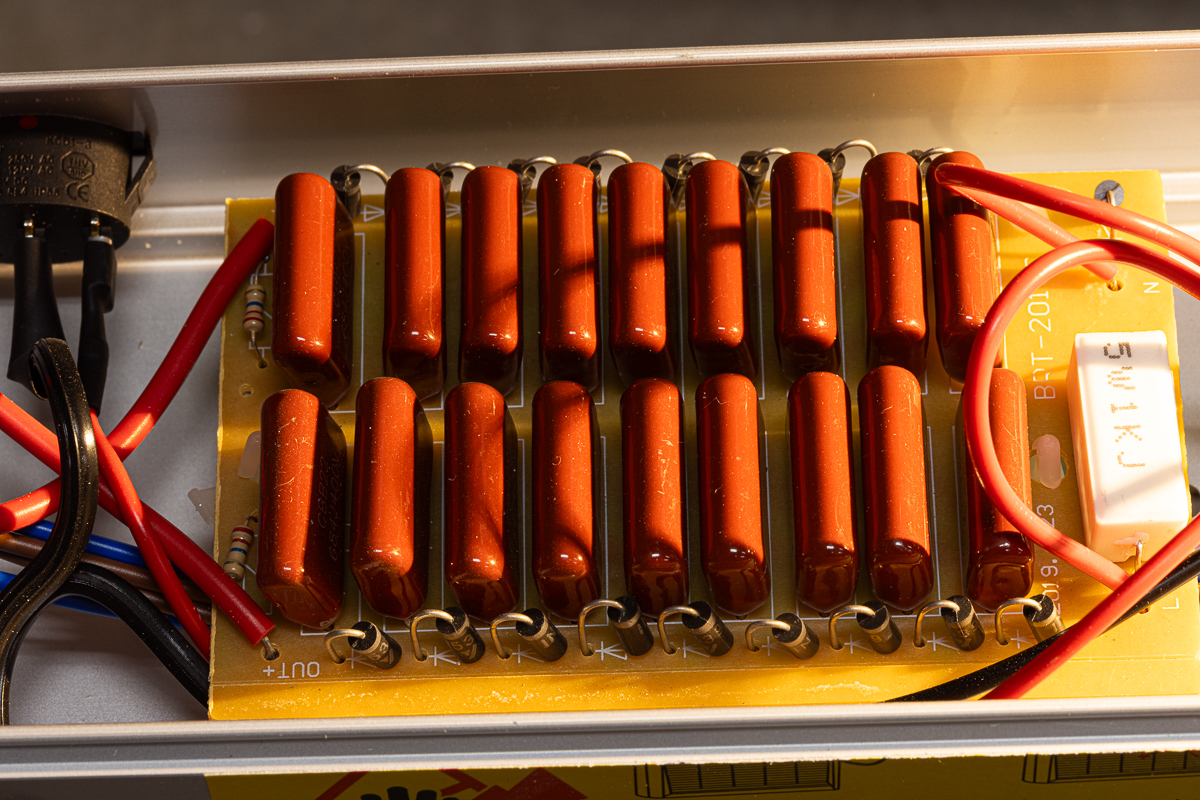
The big white 1K resistor still measures 1K.
We have 9 capacitors and 9 diodes on each side (18 caps and 18 diodes all told).
The capacitors are labeled CBB22 684J400V, so these are 0.68 uF capacitors.
Almost without a doubt this is a high voltage "ladder" or multiplier circuit, as per this article:
Now, let's assume that all 18 caps are in series and to be lazy call the input voltage 100 volts -- this should be generating 1800 volts. I won't use my tongue (or finger) to test for high voltage. I look at the Amazon listing and they claim 2800 volts.The grid spacing is 0.3 inches -- and when an insect places itself in this gap a discharge takes place. No doubt the 1K resistor limits current in these situations and is simply in series with the ladder.
I checked all the diodes "in circuit" and they are fine.
Tom's Electronics pages / tom@mmto.org